Simon Sheikh: Climate emergency strategic planning
https://www.youtube.com/watch?v=VEvTsJk_Xpo
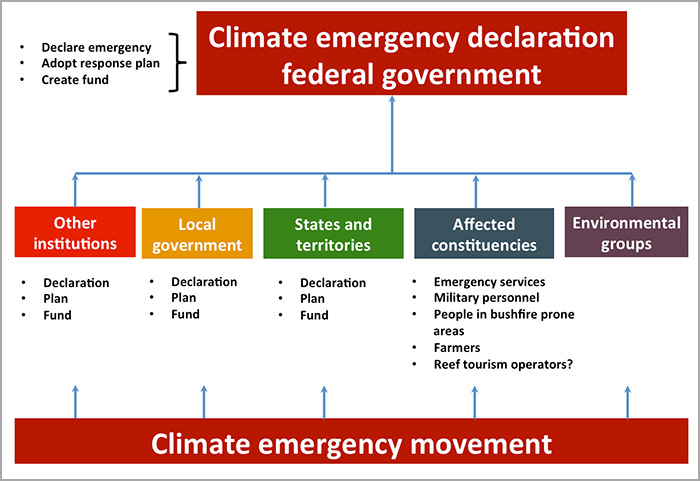
Simon Sheikh, CEO Future Super and former GetUp leader, presents his ideas as to how to create momentum on the critical path to the declaration of a climate emergency.
Constituency-based campaigning – illustration by Simon Sheikh
Mark Wakeham: Campaigning on the climate emergency – some thoughts
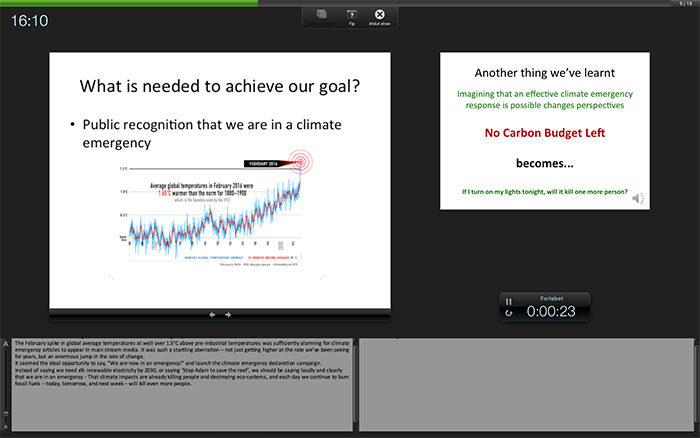
Mark Wakeham is the CEO for Environment Victoria, one of Australia’s leading environment non-government organisations. He talks about how the message that there isn’t a carbon budget left in his view is best communicated by climate action campaigners – drawing a parallel to the anti-nuclear movements’ refraining from using the mushroom-cloud in their campaigning because it they thought it would put people off. Should we or shouldn’t we be showing the mushroom-cloud of the ‘climate mind bomb’?
What is climate emergency campaigning?
· Is it reinforcing and building accurate description of the climate science within all climate campaigns?
· Is it campaigning for the declaration of a climate emergency?
· Is it campaigning for a massive emergency-speed mobilisation?
· Is it all of the above?
· Is it something else? Something additional to the above?
Does your group do climate emergency campaigning? Which type? If not why not? If so how is it going? Could you do more or it?
» More information about the Victorian Climate Action Network (VCAN) on www.vcan.net.au
With the Paris Agreement, the world decided to pursue best efforts to limit warming to below 1.5C, partly because climate impacts around 2C are considered too risky and too high by many. This seminar will put a spotlight on the mitigation side, i.e. how much and how quickly would emissions need to be reduced to still have a chance of keeping or returning warming to below 1.5C relative to pre-industrial levels.
Joeri Rogelj will present the latest scientific literature on 1.5C emission scenarios, abatement costs, mitigation technologies, and carbon budgets. How does a roadmap towards a 1.5C future differ from one for 2C? How big is the task of negative emission technologies, like biomass and CCS?
Co-hosted by the Australian-German Climate and Energy College and the EU Centre on Shared Complex Challenges
Register at Eventbrite: https://www.eventbrite.com/e/keeping-warming-to-below-15c-possible-and-if-so-how-tickets-24611945993
David Spratt, author of ‘Climate Reality Check’. Photo: Centre for Climate Safety
We need ideas leadership. The rate of climate action needs to be more urgent than the politicians want to speak about, says David Spratt, author of ‘Climate Reality Check’, in this short audio interview:
Transcript
“We need a check to see where things are at. We have had expectations about climate change – how fast things would change. We had a bit of a shock with the forest fires at Christmas in Tasmania, which for people who go bush walking was a big “Wow! I didn’t expect this this quickly!” – and we have just had some data saying that February was the hottest month on record ever by 0.2 degree – normally it is one hundredth of a degree. So I thought I should write something trying to get us up to date.
The paper is called ‘Climate Reality Check’ – and it says what is going on now, and what we need to learn from it. And the obvious answer is that it is more urgent than we thought, and the rate of action needs to be more urgent than the politicians want to speak about.”
“So are people listening?”
“Oh, look, I think we are getting a great response. It is being discussed on forums around the world. People are saying to me: ‘Yes, the climate movement, some of the big groups, have been too conservative.’
We can’t only worry about what we need to say to people in marginal seats at election time, we also need ideas leadership. I mean, it reminds me a bit about the situation before the Second World War in England, where we had a prime minister who wanted to say ‘Peace in our time’, and so on, and to make a peace pact with Germany, which wasn’t a good idea. Churchill was the opposition leader and was opposed to this, but nobody wanted to listen to him.
Then suddenly the penny dropped, and Churchill went from being this dissident voice saying ‘We’ve got a problem and we’ve really got to face that’ – to becoming prime minister. He made speeches and transformed society.
I think that is the moment we are on climate change – of saying: ‘Yes, the normal expectations won’t work. We want real leadership now!’, and… it is hard to talk about wars and leadership, but everybody knows that Churchill helped to inspire a nation and to do amazing things – and amazing things are what we have to do on climate now.”
The interview was recorded by Mik Aidt on 18 March 2016 at a national Climate Action Network conference in Melbourne, Australia.
As planet burns hot, new report shows Paris a relic of historic failure
Scientists say they are shocked and stunned by the “unprecedented” NASA temperature figures for February 2016, which are 1.65°C higher than the beginning of the 20th century and around 1.9°C warmer than the pre-industrial level.
Stefan Rahmstorf of Germany’s Potsdam Institute of Climate Impact Research says we are now “in a kind of climate emergency”.
Like the dramatic and unexpected “big melt” in the Arctic in 2007, we are now in another moment of terrifying climate reality, for Nature cannot be fooled. The recent data suggests it has taken just three months for the Paris climate accord — with its escalating emissions to 2030 — to become a relic, completely disconnected to the task the world now faces.
So what is the reality after Paris?, asks David Spratt from Climate Action Moreland.
Call for an official declaration of climate emergency
We are yet to see a ‘Churchill’-figure of our time who will champion the need to a ‘World War II-kind of mobilisation’ against the threats of global warming and climate change – with both the necessary rhetoric skills and a sufficient scientific understanding to actually make voters listen.
Barack Obama certainly did his bit towards the end of his presidency in the United States. However, as he is on his way out, American politics could quickly transform his step forward towards cleaner energy production into two fossil-fuel powered steps backwards.
Pledge to mobilise
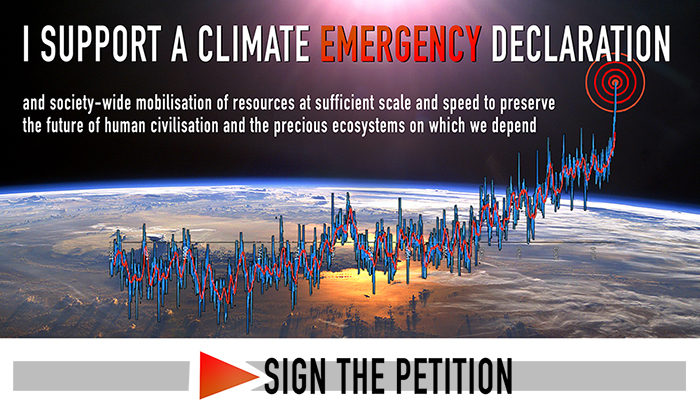
One thing we all can do is call our leaders out. Ask them if they’d be in support of emergency speed climate action, such as to reduce your country’s net greenhouse gas emissions 100 percent by 2030 at the latest and to implement far-reaching measures to remove greenhouse gases from the atmosphere. Ask them to issue and support an official declaration of climate emergency.
The Climate Mobilization encourages you to call on your nation’s government to immediately commence a social and economic mobilisation to restore a climate that is safe, stable, and supportive of human civilisation. “This heroic campaign shall be carried out on a vast scale, transforming our economy at wartime speed,” The Climate Mobilization writes, because “climate change is causing immense human suffering and damage to the natural world. It threatens the collapse of civilization within this century. Confronting this crisis is the great moral imperative of our time.”
The climate emergency: Time to switch to panic mode?
“The latest temperature data are nothing but spine-chilling. What are we seeing? Is this just a sort of a rebound from the so-called ‘pause’? Or something much more worrisome? We may be seeing something that portends a major switch in the climate system; an unexpected acceleration of the rate of change. There are reasons to be worried, very worried.”
In February 2016, ten Victorian community climate action groups sent an eight-page document to the Victorian Government outlining the actions the state government should take to drive emissions reductions, and describing the magnitude of the emissions reductions required. Here is a short summary of their recommendations:
“SET A TARGET OF ZERO EMISSIONS IN TEN YEARS
The role of state governments is particularly important if the federal government continues with policies which are not even close to those required to meet our international obligations. Victoria can be, and should be, a leader on climate action and we are heartened by your interest in this goal.
In order to secure the conditions needed for the wellbeing of current and future generations, we call on the Victorian government to ensure that Victoria’s emissions reductions targets are based on recognition of the need for an emergency transition to a zero emissions economy and for drawdown of the excess greenhouse gases already in the atmosphere.
INFORM POLICY MAKERS AND THE PUBLIC ABOUT THE NEED FOR EMERGENCY ACTION
We welcome the stronger language already being used by the Victorian government and the use of detailed briefings on likely changes in local areas as a way of engaging people in the reality of climate change. However, the job is only half done. We call on the state government to be much more direct in letting the public know that big changes are needed in order to address climate change – including a rapid transition to zero emissions – and that there is no choice as the effects of climate change are potentially catastrophic.
In particular we call on the Victorian government to:
• ensure that members of parliament and bureaucrats involved in policy and planning are well informed about the need for a rapid transition to zero emissions and the scaling up of draw-down and sequestration
• begin a process of considering how best to convey the need for large scale transformation to members of the public, so that they are inspired by the possibilities of transformation and reassured that the government recognises the seriousness of the threat
IMMEDIATE ACTION TO BEGIN REDUCING EMISSIONS TO ZERO AND BEYOND
We call on the Victorian government to implement:
• an emergency speed transition to a zero emissions economy in all sectors of society in about ten years (including stationary energy, buildings, transport, land use and industry)
• the rapid scaling up of safe measures to draw-down the excess greenhouse gases already in the atmosphere (including re-afforestation and increased levels of soil carbon).
All the technology we require to reach zero emissions is already available, what is required is the political will to drive the scale and speed of change which is required. The drawdown of greenhouse gases at the scale required will require support for further research and development of scalable and safe methods and these must be pursued as a matter of urgency.
HAVE COURAGE
We ask you to have the courage to say what Schellnhuber found too difficult to tell, and spell out in clear and evocative language both the unspeakable risks we face, and the inspiring opportunity that transition to a zero emissions society provides. We ask you to immediately begin on the path of bold and transformative action we need.
We ask you to provide the kind of leadership required at this pivotal point in history.”
“Failure to act now will haunt us till the end of time.”
~ Garnaut, 2008
Endorsed by 10 different climate action groups in Victoria, this submission was sent to the Victorian Climate Change Framework on 29 February 2016.
The Victorian government had requested input from the communities, citizens and businesses:
“The Department of Environment, Land, Water and Planning is building a framework for climate change action in Victoria that will be released in 2016. The Department want to hear about the challenges and opportunities for climate change action, your vision for a thriving and resilient future for Victoria, and how government can work with you to get us there.
The role of the Victorian Climate Change framework will be to outline:
• a shared vision for a Climate Ready Victoria in 2030,
• principles of state government focus and action,
• the role for all Victorians to support the shared vision, and
• key actions of government in mitigation and adaptation to support the vision.”
» Read or download the submission (PDF, 8 pages)
The organisers of Earth Hour ask: Will you email PM Turnbull, and ask him to get rid of wasteful fossil fuel subsidies in the next budget?
To help you get started, here’s the kind of thing you could say:
‘Dear Mr Turnbull,
The government spends around $12 billion a year on fossil fuel subsidies. That means taxpayers are paying big polluters to keep pumping out pollution, which is causing climate change. I want to see the government get rid of fossil fuel subsidies in the next budget, and instead invest in clean, renewable technology for a safer climate future.’
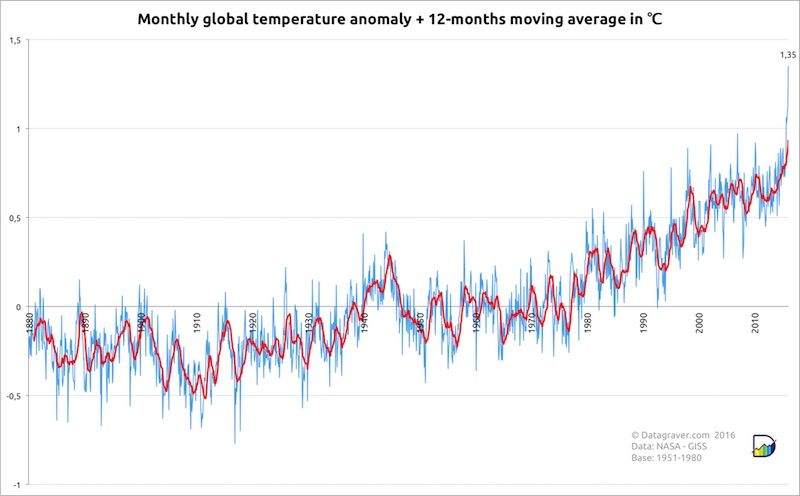
Note this anomaly is over the 1950-1980 baseline, which is 0.3°C warmer that late around 1900 and around 0.6°C warmer than true pre-industrial around 1750. This is close to 2°C warmer the true pre-industrial temperature. As Professor Michael E Mann of “hockey stick” fame says on Twitter:
“Feb GISTEMP +1.35C 1951- is ~2C relative to true pre-industrial baseline”
David Spratt commented: “This is seriously crazy. Before October 2015, the highest GISS monthly anomaly was 0.96°C (Jan ’07). The last five months: 1.06°C, 1.03°C, 1.10°C, 1.14°C, 1.35°C! And March is also running above 1.3°C. It seems that the UK Met Office predicting that 2016 will be hotter than record breaking 2015 is on track.”
“Compared with the rival record giant El Nino of 1997-98, global temperatures are running about 0.5 degrees hotter.
That shows how much much global warming we have had since then. The first half of March 2016 is at least as warm, and it means temperatures are clearly more than 1.5 degrees above pre-industrial levels.” Stefan Rahmstorf, professor at Potsdam Climate Institute & UNSW
“This is really quite stunning … it’s completely unprecedented,” said Stefan Rahmstorf, from Germany’s Potsdam Institute of Climate Impact Research and a visiting professorial fellow at the University of NSW, noting the NASA data as reported by the Wunderground blog.
“We are in a kind of climate emergency now,” Professor Rahmstorf said, noting that global carbon dioxide levels last year rose by a record rate of more than 3 parts per million.
Something to write in the diary: 2016 is the first year that global temperatures exceeded 1.5°C over the preindustrial level.
Changes in the climate are already happening in northern Victoria and southern NSW. Recent research from the Australian Export Grains Innovation Centre (AEGIC) says the region is already experiencing a ‘new climate’, one that has become noticeable since about 2000. This is most noticeable in the shift of rainfall patterns. Meanwhile research carried out for the state government documents – yet again – the expected increases in average temperature, extended heatwaves and ongoing water stress that is coming with climate change.
Farmers across 11 western Victorian shires have been given access to risk management grants of up to $10,000 and a second round of $2000 stock containment grants under the State Government’s $10 million Drought Support Fund.
“It’s valuable support at a time when drought conditions are looking grim, right across the state,” Victorian Farmers Federation President Peter Tuohey said. “This funding will help our farmers deal with the impacts of drought and the ongoing dry that’s undermining the carrying capacity of many farms as they face repeated seasons of low rainfall and stock water shortages.”
The $10m Drought Support Fund includes $1.5m for Farm Risk Management Grants, with farmers able to claim $3000 to do a business plan and up to another $7000 for training or to build on-farm infrastructure to help manage climatic risks.
Rough start to the year
The Australian Youth Climate Coalition wrote:
“On 3 March 2016, for the first time in human history, we passed a scary milestone for extreme heat. In the Northern Hemisphere temperatures briefly breached the two degree warming limit scientists have long warned of.
A warning sign that makes the shift to 100% clean energy and keeping fossil fuels in the ground so necessary.
Then we heard that abnormally warm waters on the Great Barrier Reef are causing huge coral bleaching at several locations, very likely to only get worse, increasing to the highest warning level and possibly killing off coral in many areas.
For too long Australia has mined and burned the polluting fuels at the heart of this problem. Prime Minister Turnbull can do better.
It’s time for Prime Minister Turnbull and his government to turn this around. Call Turnbull today and tell him that you want a commitment to 100% renewable energy and keeping coal in the ground this election year. ”